Anthropic’s Claude 3.7 Sonnet hybrid reasoning model is now available in Europe (London). Claude 3.7 Sonnet offers advanced AI capabilities with both quick responses and extended, step-by-step thinking made visible to the user. This model has strong capabilities in coding and brings enhanced performance across various tasks, like instruction following, math, and physics.
Claude 3.7 Sonnet introduces a unique approach to AI reasoning by integrating it seamlessly with other capabilities. Unlike traditional models that separate quick responses from those requiring deeper thought, Claude 3.7 Sonnet allows users to toggle between standard and extended thinking modes. In standard mode, it functions as an upgraded version of Claude 3.5 Sonnet. In extended thinking mode, it employs self-reflection to achieve improved results across a wide range of tasks. Amazon Bedrock customers can adjust how long the model thinks, offering a flexible trade-off between speed and answer quality. Additionally, users can control the reasoning budget by specifying a token limit, enabling more precise cost management.
Claude 3.7 Sonnet is also available on Amazon Bedrock in the Europe (Frankfurt), Europe (Ireland), Europe (Paris), Europe (Stockholm), US East (N. Virginia), US East (Ohio), and US West (Oregon) regions. To get started, visit the Amazon Bedrock console. Integrate it into your applications using the Amazon Bedrock API or SDK. For more information, see the AWS News Blog and Claude in Amazon Bedrock.
Anthropic’s Claude 3.7 Sonnet hybrid reasoning model is now available in Europe (London). Claude 3.7 Sonnet offers advanced AI capabilities with both quick responses and extended, step-by-step thinking made visible to the user. This model has strong capabilities in coding and brings enhanced performance across various tasks, like instruction following, math, and physics. Claude 3.7 Sonnet introduces a unique approach to AI reasoning by integrating it seamlessly with other capabilities. Unlike traditional models that separate quick responses from those requiring deeper thought, Claude 3.7 Sonnet allows users to toggle between standard and extended thinking modes. In standard mode, it functions as an upgraded version of Claude 3.5 Sonnet. In extended thinking mode, it employs self-reflection to achieve improved results across a wide range of tasks. Amazon Bedrock customers can adjust how long the model thinks, offering a flexible trade-off between speed and answer quality. Additionally, users can control the reasoning budget by specifying a token limit, enabling more precise cost management. Claude 3.7 Sonnet is also available on Amazon Bedrock in the Europe (Frankfurt), Europe (Ireland), Europe (Paris), Europe (Stockholm), US East (N. Virginia), US East (Ohio), and US West (Oregon) regions. To get started, visit the Amazon Bedrock console. Integrate it into your applications using the Amazon Bedrock API or SDK. For more information, see the AWS News Blog and Claude in Amazon Bedrock.
Starting today, you can use E-RTMP (Enhanced Real-Time Messaging Protocol) multitrack video to send multiple video qualities to your Amazon Interactive Video Service (Amazon IVS) stages. This feature enables adaptive bitrate streaming, allowing viewers to watch in the best quality for their network connection. Multitrack video is supported in OBS Studio and complements the existing simulcast capabilities in the IVS broadcast SDK. There is no additional cost for using multitrack video with Real-Time Streaming.
Amazon IVS is a managed live streaming solution designed to make low-latency or real-time video available to viewers around the world. Visit the AWS region table for a full list of AWS Regions where the Amazon IVS console and APIs for control and creation of video streams are available.
Starting today, you can use E-RTMP (Enhanced Real-Time Messaging Protocol) multitrack video to send multiple video qualities to your Amazon Interactive Video Service (Amazon IVS) stages. This feature enables adaptive bitrate streaming, allowing viewers to watch in the best quality for their network connection. Multitrack video is supported in OBS Studio and complements the existing simulcast capabilities in the IVS broadcast SDK. There is no additional cost for using multitrack video with Real-Time Streaming. Amazon IVS is a managed live streaming solution designed to make low-latency or real-time video available to viewers around the world. Visit the AWS region table for a full list of AWS Regions where the Amazon IVS console and APIs for control and creation of video streams are available. To learn more, please visit the Amazon IVS RTMP ingest documentation page.
Creen videos con sus palabras de forma gratuita – Presentamos Bing Video Creator
Publicado en: Blog de Microsoft Bing.
Las preguntas merecen respuestas, las ideas piden ser realizadas y la curiosidad busca satisfacción. Hace dos años, presentamos esta creencia con Bing Image Creator, para ayudar a los usuarios de todo el mundo a crear lo que puedan imaginar a través de las palabras, de forma gratuita. El mes pasado, continuamos con la próxima evolución de la búsqueda con Copilot Search en Bing, donde combinamos lo mejor de la búsqueda tradicional y generativa para encontrarlos en el punto en el que se encuentran en su viaje de descubrimiento.
Hoy damos el siguiente paso con Bing Video Creator, que les permite convertir sus ideas en vídeos de forma gratuita. Con la tecnología de Sora, Bing Video Creator transforma sus mensajes de texto en videos cortos. Solo describan lo que quieren ver y observen cómo su visión cobra vida.
Bing, como motor de búsqueda y respuestas impulsado por IA, no solo los ayuda a encontrar lo que necesitan, sino que les da la libertad de crear justo lo que buscan.
Bing Video Creator es gratuito y se implementará a partir de hoy en la aplicación móvil de Bing y pronto llegará al escritorio y dentro de Copilot Search. Para empezar, descarguen la aplicación Bing Mobile.
Llevar la creación al alcance de su mano
Bing Video Creator representa nuestros esfuerzos por democratizar el poder de la generación de videos con IA. Creemos que la creatividad debe ser sencilla y accesible para ayudarlos a satisfacer su proceso de búsqueda de respuestas.
Ya sea que den rienda suelta a su imaginación, den vida a una historia o busquen el video perfecto para comunicar lo que piensan, Bing Video Creator pone el poder de la creación de videos al alcance de su mano. Estamos emocionados de empoderar a cualquiera para que convierta sus palabras en maravillas a través de un video generado por IA.
Cómo usar Bing Video Creator
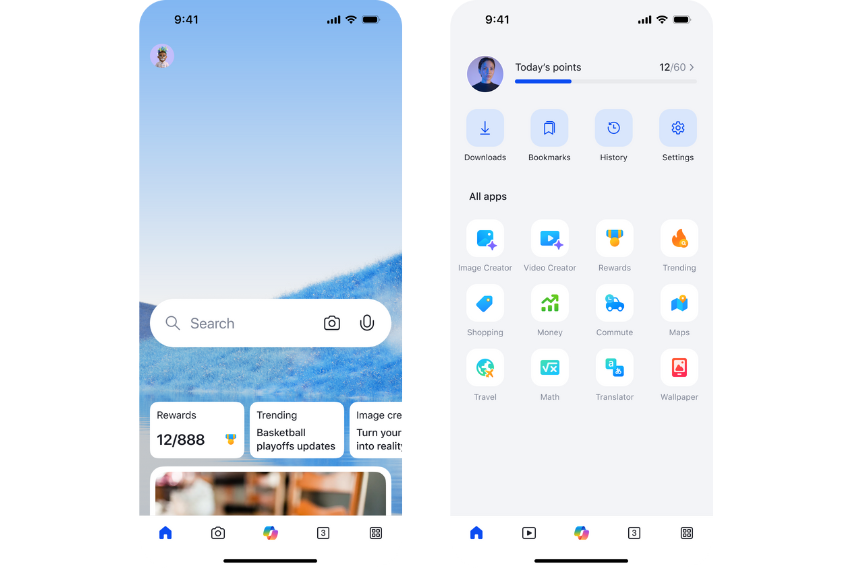
Empezar a usar Bing Video Creator es fácil. Abran Video Creator dentro de la aplicación Bing Mobile al hacer clic en el menú en la esquina inferior derecha y seleccionar «Video Creator» (Creador de Video). También pueden escribir directo en la barra de búsqueda de la aplicación móvil de Bing «Crear un vídeo de…» para un acceso rápido a la creación de vídeos. Una vez que Bing Video Creator esté disponible en el escritorio, pueden visitar Bing.com/create.
Abran la aplicación Bing y hagan clic en el menú en la esquina inferior derecha, luego seleccionen «Creador de video».
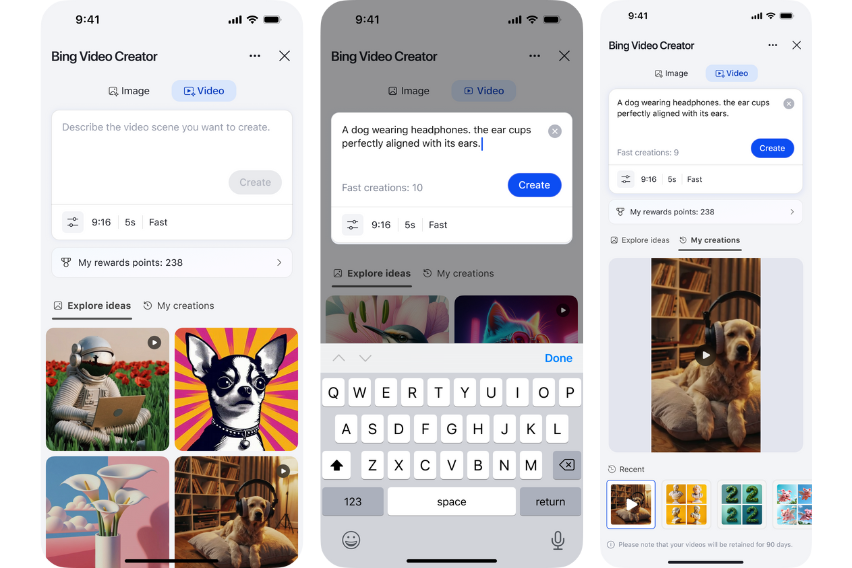
Luego, solo escriban una descripción del video que desean crear en la caja de prompt. Los mejores prompts proporcionan contexto, descripción y detalles adicionales. Hagan clic en «Crear» y dejen que la IA genere su video. Siéntanse libres de continuar con sus sueños con nuevos videos: recibirán una notificación cuando su video esté listo para ver.
Den un vistazo a este divertido prompt a continuación: «En una concurrida pizzería italiana, una pequeña nutria trabaja como chef y usa un sombrero de chef y un delantal. Amasa la masa con sus patas y está rodeado de otros ingredientes de la pizza».
Los videos duran 5 segundos y se pueden crear en formato 9:16, y pronto en formato 16:9. También pueden poner en cola hasta tres generaciones de vídeo a la vez. Si las tres ranuras están en uso, deberán esperar a que una termine antes de comenzar otra.
Una vez que su video haya terminado de generarse, recibirán una notificación conveniente que les informará que su video está listo. Pueden optar por descargar el video, compartirlo por correo electrónico o a través de sus plataformas de redes sociales favoritas, o copiar y compartir un enlace directo al video.
Sus creaciones se almacenan hasta por 90 días, lo que les da tiempo suficiente para descargar, compartir o refinar sus prompts.
La creación de videos es gratuita para todos los usuarios, con la posibilidad de elegir entre velocidades de generación Rápida y Estándar. Comiencen con 10 creaciones rápidas para que su imaginación cobre vida en segundos. Después de eso, hagan que la creatividad fluya sin interrupciones al canjear 100 puntos de Microsoft Rewards por cada creación rápida o continúa con las velocidades de creación estándar.*
Bing Video Creator se lanzará a partir de hoy en todo el mundo (excepto en China y Rusia).
Casos de uso e inspiración
Bing Video Creator es para cualquiera que tenga una historia que contar. Aquí hay algunas formas en que pueden usarlo:
1. Momentos especiales: ¿Necesitan una imagen rápida y atractiva para conmemorar un momento especial? ¡Generen un video corto que le dé vida!
2. Comunicación: Conviertan su idea en algo fácil de entender, una broma en un recuerdo duradero o añadan una experiencia personalizada a sus conversaciones cotidianas. O destaquen en el desplazamiento al compartir su creación en las redes sociales.
3. Descubrimiento: La lluvia de ideas es ahora más fácil que nunca con la capacidad de probar direcciones creativas, explorar diferentes estilos, dar vida a objetos, crear tableros de estado de ánimo y más. Es una excelente manera de dejar que su curiosidad deambule con libertad y descubrir lo que pueden imaginar.
Consejos y trucos
Tanto si apenas empiezan como si quieren perfeccionar sus vídeos generados por IA, estos consejos les ayudarán a desbloquear todo el potencial de Bing Video Creator.
1. Sean descriptivos con sus prompts Cuanto más vívidos y específicos sean sus prompts, mejores serán los resultados. En lugar de «una persona que camina», prueben con «una mujer joven con un abrigo rojo camina por un bosque nevado al amanecer». Cuanto más detalle, mejor. Incluir los ángulos de la cámara y la iluminación también ayuda a que el modelo ofrezca lo que buscan.
2. Utilicen lenguaje orientado a la acción y a la puesta en escena Verbos como «bailar», «explorar» o «transformar» ayudan a la IA a entender el movimiento y la intención, lo que da lugar a imágenes más dinámicas. Adjetivos como «cinematográfico», «soleado» o «de ensueño» ayudan a crear la sensación general del video.
3. Experimenten con el tono y el estilo ¿Quieren algo cinematográfico? Añadan «al estilo del tráiler de una película». ¿Buscan algo divertido? Intenten «animado como una caricatura». Los modificadores de prompt pueden cambiar de manera importante la estética.
IA Responsable
En Microsoft, nuestros equipos se guían por nuestros principios de IA Responsable y el estándar de IA Responsable para ayudarles a desarrollar e implementar sistemas de IA de forma responsable. Para frenar el posible uso indebido de Video Creator, hemos utilizado las salvaguardas Sora existentes de OpenAI e incorporado protecciones adicionales para ofrecer una experiencia que fomente el uso responsable de Video Creator. Por ejemplo, hemos implementado controles que tienen como objetivo limitar la generación de videos dañinos o inseguros. Cuando nuestro sistema detecta que un video, en potencia dañino, podría ser generado por un prompt, se bloquea el prompt y advierte al usuario. Para cada vídeo creado con Bing Video Creator, hemos implementado credenciales de contenido y procedencia basadas en el estándar C2PA para ayudar a los usuarios a identificar los vídeos generados por IA.
Prueben Bing Video Creator hoy mismo
Estamos ansiosos por ver lo que crean con Bing Video Creator. Seguimos con las mejoras y la evolución de la experiencia a medida que llevamos la generación de vídeos a más usuarios. Prueben Bing Video Creator hoy mismo: https://aka.ms/TryBingVideoCreator
El equipo de Bing
*Hasta 10 creaciones Rápidas por usuario. A partir de entonces, las creaciones se procesarán a la velocidad estándar. Para continuar con el uso de las creaciones rápidas, los usuarios pueden canjear 100 puntos de Microsoft Rewards por cada vídeo. Más información sobre cómo ganar puntos Rewards aquí.
Starting today, Amazon EC2 High Memory U7i instances with 8TB of memory (u7i-8tb.112xlarge) are now available in the US West (Oregon) region. U7i-8tb instances are part of AWS 7th generation and are powered by custom fourth generation Intel Xeon Scalable Processors (Sapphire Rapids). U7i-8tb instances offer 8TiB of DDR5 memory enabling customers to scale transaction processing throughput in a fast-growing data environment.
U7i-8tb instances offer 448 vCPUs, support up to 60Gbps Elastic Block Storage (EBS) for faster data loading and backups, deliver up to 100Gbps of network bandwidth, and support ENA Express. U7i instances are ideal for customers using mission-critical in-memory databases like SAP HANA, Oracle, and SQL Server.
Starting today, Amazon EC2 High Memory U7i instances with 8TB of memory (u7i-8tb.112xlarge) are now available in the US West (Oregon) region. U7i-8tb instances are part of AWS 7th generation and are powered by custom fourth generation Intel Xeon Scalable Processors (Sapphire Rapids). U7i-8tb instances offer 8TiB of DDR5 memory enabling customers to scale transaction processing throughput in a fast-growing data environment. U7i-8tb instances offer 448 vCPUs, support up to 60Gbps Elastic Block Storage (EBS) for faster data loading and backups, deliver up to 100Gbps of network bandwidth, and support ENA Express. U7i instances are ideal for customers using mission-critical in-memory databases like SAP HANA, Oracle, and SQL Server. To learn more about U7i instances, visit the High Memory instances page.
Today, AWS announced support for job metadata logs for AWS Parallel Computing Service (PCS). With this launch, PCS can be configured to emit job completion logs to Amazon CloudWatch Logs, Amazon S3, and Amazon Data Firehose. Each job log will contain detailed metadata including information such as job submission time, start time, completed time, user who submitted the job, queue that processed the job, and Amazon EC2 instances used to run the job. Using these logs, you can analyze usage patterns, identify and troubleshoot job failures, track job wait times in the queue, generate user-level usage reports, and more.
This feature is available in all AWS Regions where PCS is available. You can enable job completion metadata logging on all newly-created PCS clusters in just a few clicks using the AWS Management Console. Visit our job completion documentation page to learn more.
Today, AWS announced support for job metadata logs for AWS Parallel Computing Service (PCS). With this launch, PCS can be configured to emit job completion logs to Amazon CloudWatch Logs, Amazon S3, and Amazon Data Firehose. Each job log will contain detailed metadata including information such as job submission time, start time, completed time, user who submitted the job, queue that processed the job, and Amazon EC2 instances used to run the job. Using these logs, you can analyze usage patterns, identify and troubleshoot job failures, track job wait times in the queue, generate user-level usage reports, and more. This feature is available in all AWS Regions where PCS is available. You can enable job completion metadata logging on all newly-created PCS clusters in just a few clicks using the AWS Management Console. Visit our job completion documentation page to learn more.
Starting today, Amazon Elastic Compute Cloud (Amazon EC2) C8g instances are available in AWS Canada (Central) and AWS Asia Pacific (Malaysia) regions. These instances are powered by AWS Graviton4 processors and deliver up to 30% better performance compared to AWS Graviton3-based instances. Amazon EC2 C8g instances are built for compute-intensive workloads, such as high performance computing (HPC), batch processing, gaming, video encoding, scientific modeling, distributed analytics, CPU-based machine learning (ML) inference, and ad serving. These instances are built on the AWS Nitro System, which offloads CPU virtualization, storage, and networking functions to dedicated hardware and software to enhance the performance and security of your workloads.
AWS Graviton4-based Amazon EC2 instances deliver the best performance and energy efficiency for a broad range of workloads running on Amazon EC2. These instances offer larger instance sizes with up to 3x more vCPUs and memory compared to Graviton3-based Amazon C7g instances. AWS Graviton4 processors are up to 40% faster for databases, 30% faster for web applications, and 45% faster for large Java applications than AWS Graviton3 processors. C8g instances are available in 12 different instance sizes, including two bare metal sizes. They offer up to 50 Gbps enhanced networking bandwidth and up to 40 Gbps of bandwidth to the Amazon Elastic Block Store (Amazon EBS).
Starting today, Amazon Elastic Compute Cloud (Amazon EC2) C8g instances are available in AWS Canada (Central) and AWS Asia Pacific (Malaysia) regions. These instances are powered by AWS Graviton4 processors and deliver up to 30% better performance compared to AWS Graviton3-based instances. Amazon EC2 C8g instances are built for compute-intensive workloads, such as high performance computing (HPC), batch processing, gaming, video encoding, scientific modeling, distributed analytics, CPU-based machine learning (ML) inference, and ad serving. These instances are built on the AWS Nitro System, which offloads CPU virtualization, storage, and networking functions to dedicated hardware and software to enhance the performance and security of your workloads. AWS Graviton4-based Amazon EC2 instances deliver the best performance and energy efficiency for a broad range of workloads running on Amazon EC2. These instances offer larger instance sizes with up to 3x more vCPUs and memory compared to Graviton3-based Amazon C7g instances. AWS Graviton4 processors are up to 40% faster for databases, 30% faster for web applications, and 45% faster for large Java applications than AWS Graviton3 processors. C8g instances are available in 12 different instance sizes, including two bare metal sizes. They offer up to 50 Gbps enhanced networking bandwidth and up to 40 Gbps of bandwidth to the Amazon Elastic Block Store (Amazon EBS). To learn more, see Amazon EC2 C8g Instances. To explore how to migrate your workloads to Graviton-based instances, see AWS Graviton Fast Start program and Porting Advisor for Graviton. To get started, see the AWS Management Console.
AWS is expanding resource control policies (RCPs) support to include two additional services: Amazon Elastic Container Registry and Amazon OpenSearch Serverless. This expansion enhances your ability to centrally establish a data perimeter across a wider range of AWS resources in your organization.
RCPs are available in all AWS commercial Regions and AWS GovCloud (US) Regions. To learn more about RCPs and view the full list of supported AWS services, visit the Resource control policies (RCPs) documentation in the AWS Organizations User Guide.
AWS is expanding resource control policies (RCPs) support to include two additional services: Amazon Elastic Container Registry and Amazon OpenSearch Serverless. This expansion enhances your ability to centrally establish a data perimeter across a wider range of AWS resources in your organization. RCPs are available in all AWS commercial Regions and AWS GovCloud (US) Regions. To learn more about RCPs and view the full list of supported AWS services, visit the Resource control policies (RCPs) documentation in the AWS Organizations User Guide.
Amazon Web Services (AWS) announces the availability of Amazon EC2 I7ie instances in the AWS Europe (Spain) region. Designed for large storage I/O intensive workloads, these new instances are powered by 5th generation Intel Xeon Scalable processors with an all-core turbo frequency of 3.2 GHz, offering up to 40% better compute performance and 20% better price performance over existing I3en instances.
I7ie instances offer up to 120TB local NVMe storage density—the highest available in the cloud for storage optimized instances—and deliver up to twice as many vCPUs and memory compared to prior generation instances. Powered by 3rd generation AWS Nitro SSDs, these instances achieve up to 65% better real-time storage performance, up to 50% lower storage I/O latency, and 65% lower storage I/O latency variability compared to existing I3en instances. Additionally, the 16KB torn write prevention feature, enables customers to eliminate performance bottlenecks for database workloads.
I7ie instances are high-density storage-optimized instances, for workloads that demand rapid local storage with high random read/write performance and consistently low latency for accessing large data sets. These versatile instances are offered in eleven different sizes including 2 metal sizes, providing flexibility to match customers computational needs. They deliver up to 100 Gbps of network performance bandwidth, and 60 Gbps of dedicated bandwidth for Amazon Elastic Block Store (EBS), ensuring fast and efficient data transfer for the most demanding applications.
Amazon Web Services (AWS) announces the availability of Amazon EC2 I7ie instances in the AWS Europe (Spain) region. Designed for large storage I/O intensive workloads, these new instances are powered by 5th generation Intel Xeon Scalable processors with an all-core turbo frequency of 3.2 GHz, offering up to 40% better compute performance and 20% better price performance over existing I3en instances. I7ie instances offer up to 120TB local NVMe storage density—the highest available in the cloud for storage optimized instances—and deliver up to twice as many vCPUs and memory compared to prior generation instances. Powered by 3rd generation AWS Nitro SSDs, these instances achieve up to 65% better real-time storage performance, up to 50% lower storage I/O latency, and 65% lower storage I/O latency variability compared to existing I3en instances. Additionally, the 16KB torn write prevention feature, enables customers to eliminate performance bottlenecks for database workloads. I7ie instances are high-density storage-optimized instances, for workloads that demand rapid local storage with high random read/write performance and consistently low latency for accessing large data sets. These versatile instances are offered in eleven different sizes including 2 metal sizes, providing flexibility to match customers computational needs. They deliver up to 100 Gbps of network performance bandwidth, and 60 Gbps of dedicated bandwidth for Amazon Elastic Block Store (EBS), ensuring fast and efficient data transfer for the most demanding applications. To learn more, visit the I7ie instances page.
Today, AWS announced major enhancements to its AWS Government Competency, introducing three categories to help public sector customers effectively identify and engage with validated AWS Partners. This update consolidates and streamlines AWS’s public sector partner offerings by merging the AWS Public Safety Competency and AWS Smart City Competency under the Government Competency.
This update features three distinct categories: Citizen Services, Defense & National Security, and Public Safety. The new structure enables government customers to quickly find partners with specific expertise aligned to their mission requirements. Partners in the program must meet rigorous technical validation requirements and demonstrate proven success in their designated categories, ensuring customers can confidently select partners who understand their unique compliance, security, and procurement needs.
AWS has also enhanced the program benefits for qualified partners, including new technical and go-to-market enablement resources, early access to new solutions development tools, and exclusive networking opportunities. Partners will receive specialized support tailored to their focus areas, helping them better serve government customers’ evolving needs.
The AWS Government Competency Program, which has grown from 24 partners in 2016 to more than 169 partners globally, will maintain its high standards through a new re-validation process. This ensures that partners continue to meet the technical expertise, customer success, and compliance requirements that government customers expect.
To learn more about the AWS Government Competency Program and find qualified partners, visit the AWS Government Competency webpage. Government organizations interested in working with AWS Government Competency Partners can start exploring partner solutions today.
Today, AWS announced major enhancements to its AWS Government Competency, introducing three categories to help public sector customers effectively identify and engage with validated AWS Partners. This update consolidates and streamlines AWS’s public sector partner offerings by merging the AWS Public Safety Competency and AWS Smart City Competency under the Government Competency. This update features three distinct categories: Citizen Services, Defense & National Security, and Public Safety. The new structure enables government customers to quickly find partners with specific expertise aligned to their mission requirements. Partners in the program must meet rigorous technical validation requirements and demonstrate proven success in their designated categories, ensuring customers can confidently select partners who understand their unique compliance, security, and procurement needs. AWS has also enhanced the program benefits for qualified partners, including new technical and go-to-market enablement resources, early access to new solutions development tools, and exclusive networking opportunities. Partners will receive specialized support tailored to their focus areas, helping them better serve government customers’ evolving needs. The AWS Government Competency Program, which has grown from 24 partners in 2016 to more than 169 partners globally, will maintain its high standards through a new re-validation process. This ensures that partners continue to meet the technical expertise, customer success, and compliance requirements that government customers expect. To learn more about the AWS Government Competency Program and find qualified partners, visit the AWS Government Competency webpage. Government organizations interested in working with AWS Government Competency Partners can start exploring partner solutions today.