Amazon DynamoDB Streams is a serverless data streaming feature that makes it straightforward to track, process, and react to item-level changes in DynamoDB tables in near real time. Today, DynamoDB has added support for KCL 3.0. With KCL 3.0, you can reduce compute costs to process streaming data by up to 33% compared to previous KCL versions. KCL 3.0 introduces an enhanced load balancing algorithm that continuously monitors resource utilization of the stream processing workers and automatically redistributes the load from over-utilized workers to other underutilized workers. Additionally, KCL 3.0 is built with the AWS SDK for Java 2.x for improved performance and security features, fully removing the dependency on the AWS SDK for Java 1.x.
Kinesis Client Library (KCL) is an open-source library that simplifies the development of stream processing applications with Amazon DynamoDB Streams. It manages complex tasks associated with distributed computing such as load balancing streaming data, processing data with fault-tolerance, and coordinating distributed workers, allowing you to solely focus on your core business logic. You can upgrade your stream processing application running on KCL 1.x by simply replacing the current library to use KCL 3.0 without any changes in your data processing logic. For migration instructions, see Migrating from KCL 1.x to KCL 3.x.
Amazon DynamoDB Streams is a serverless data streaming feature that makes it straightforward to track, process, and react to item-level changes in DynamoDB tables in near real time. Today, DynamoDB has added support for KCL 3.0. With KCL 3.0, you can reduce compute costs to process streaming data by up to 33% compared to previous KCL versions. KCL 3.0 introduces an enhanced load balancing algorithm that continuously monitors resource utilization of the stream processing workers and automatically redistributes the load from over-utilized workers to other underutilized workers. Additionally, KCL 3.0 is built with the AWS SDK for Java 2.x for improved performance and security features, fully removing the dependency on the AWS SDK for Java 1.x. Kinesis Client Library (KCL) is an open-source library that simplifies the development of stream processing applications with Amazon DynamoDB Streams. It manages complex tasks associated with distributed computing such as load balancing streaming data, processing data with fault-tolerance, and coordinating distributed workers, allowing you to solely focus on your core business logic. You can upgrade your stream processing application running on KCL 1.x by simply replacing the current library to use KCL 3.0 without any changes in your data processing logic. For migration instructions, see Migrating from KCL 1.x to KCL 3.x. KCL 3.0 is available with Amazon DynamoDB Streams in all AWS Regions. To learn more, refer to Working with DynamoDB Streams in the DynamoDB Developer Guide.
AWS Deadline Cloud monitor now includes a worker dashboard that makes it easy to monitor the performance of your workers. AWS Deadline Cloud is a fully managed service that simplifies render management for teams creating computer-generated graphics and visual effects for films, television, broadcasting, web content, and design.
Understanding the CPU and memory usage of workers in a render farm is critical to ensuring efficient resource usage and rapidly troubleshooting issues. When renders are taking longer than expected, the worker dashboard helps determine if your instances are adequately sized for your workloads. Even when tasks are completing successfully, there may be opportunities to optimize your costs. The worker dashboard can reveal if you’re using larger instances than your workloads require.
Worker dashboard for AWS Deadline Cloud Monitor is available in all AWS Regions where the service is offered.
AWS Deadline Cloud monitor now includes a worker dashboard that makes it easy to monitor the performance of your workers. AWS Deadline Cloud is a fully managed service that simplifies render management for teams creating computer-generated graphics and visual effects for films, television, broadcasting, web content, and design. Understanding the CPU and memory usage of workers in a render farm is critical to ensuring efficient resource usage and rapidly troubleshooting issues. When renders are taking longer than expected, the worker dashboard helps determine if your instances are adequately sized for your workloads. Even when tasks are completing successfully, there may be opportunities to optimize your costs. The worker dashboard can reveal if you’re using larger instances than your workloads require. Worker dashboard for AWS Deadline Cloud Monitor is available in all AWS Regions where the service is offered.
To learn more about AWS Deadline Cloud worker dashboard see the AWS Deadline Cloud documentation.
Empoderar a los estudiantes adolescentes para que logren más con Copilot Chat y Microsoft 365 Copilot
Por: Equipo de Microsoft Educación.
Nos complace anunciar que la disponibilidad de Copilot Chat y Microsoft 365 Copilot para estudiantes mayores de 13 años llegará este verano con protección de datos empresariales y controles de TI. La IA ofrece oportunidades de aprendizaje nuevas y únicas cuando se integra de forma reflexiva como complemento de las prácticas establecidas con las aportaciones de los educadores. Un estudio de Microsoft Research descubrió que la mayoría de los estudiantes demostraron una curiosidad notable al usar la IA, al hacer preguntas sofisticadas que se extendían más allá de la tarea en cuestión y conducían a una comprensión más profunda. Además, el último informe de LinkedIn hace un llamado a la acción para equipar a la futura fuerza laboral con IA y habilidades exclusivas de los seres humanos, ya que la demanda aumenta de manera rápida.
Somos optimistas sobre las oportunidades que se avecinan para ayudar a los estudiantes a avanzar en su aprendizaje y desarrollar habilidades para prepararse para el éxito en su futuro. Compartiremos el impacto y las perspectivas de nuestra versión preliminar privada para estudiantes de 13 años o más, detalles del producto y recursos para ayudarlo a comenzar.
Aumentar la agencia de los estudiantes con Copilot Chat
A lo largo de nuestra vista previa, escuchamos comentarios de instituciones de K-12 que reforzaron la importancia de brindar capacitación y apoyo a educadores y estudiantes, establecer pautas adecuadas y otorgar permiso para experimentar y aprender juntos. También demostraron lo que es posible cuando se satisfacen estas necesidades. Lean a continuación para conocer los testimonios de las Escuelas del Condado de Fulton y Brisbane Catholic Education, con más información de nuestra vista previa y recursos más adelante en el blog.
Las Escuelas del Condado de Fulton primero establecieron una base con un grupo de trabajo de IA, la evaluación de más de 200 casos de uso y la alineación en objetivos críticos, como preparar a los estudiantes para su futuro y dar a cada estudiante la oportunidad de aprender de la manera que mejor les funcione. Después de la capacitación inicial, los educadores introdujeron Copilot Chat como un compañero de pensamiento, brindaron orientación sobre temas como la creación de prompts y rápido vieron aumentar la confianza y la curiosidad de los estudiantes. Los estudiantes lo usaron para idear, recibir retroalimentación inmediata sin juicios, diseñar proyectos multimedia, identificar y corregir errores de código, ajustar el contenido según sus preferencias o ritmo y administrar su tiempo. Los educadores también pueden ahora desafiarlos más que nunca, y los estudiantes utilizan Copilot Chat como un multiplicador de fuerza para dar vida a sus ideas y pasiones de formas que antes no podían imaginar o acceder.
Escuchen a los educadores y estudiantes de Johns Creek High School compartir su experiencia con Copilot Chat en sus propias palabras en el siguiente video y lean la historia completa.
Para Brisbane Catholic Education (BCE), el recorrido comenzó con un plan para usar la IA para respaldar su misión de enseñar, desafiar y transformar en un momento en el que existen crecientes necesidades de reducción de la carga de trabajo administrativo y evolución de los modelos de aprendizaje para los estudiantes nativos digitales. En una prueba preliminar, los educadores informaron haber ahorrado un promedio de 9,3 horas por semana, lo que contribuyó al interés y la confianza de BCE para expandir el acceso de manera más amplia. Copilot Chat aumentó la agencia de los estudiantes, permitió más trabajo basado en proyectos y aceleró un cambio que han tratado de hacer durante años para ayudar a los estudiantes a convertirse en verdad en aprendices, no solo en receptores de conocimientos. Shane Tooley, subdirector, señaló: «La verdadera promesa de Copilot Chat no es la eficiencia, sino la cognición. Nos ayuda a empujar a los estudiantes más allá del recuerdo de conocimientos hacia la evaluación, la síntesis y la justificación».
El éxito de BCE se basó en una fuerte aceptación por parte de los líderes, la alineación de la IA con objetivos estratégicos más amplios, la medición continua y el compromiso transparente con oportunidades para el diseño conjunto. Generó nuevas formas de pensar, una cultura de compartir y una reflexión reflexiva sobre el futuro de la educación. Obtengan más información sobre cómo BCE aumenta la agencia y la eficiencia con Copilot Chat y Microsoft 365 Copilot.
Mi papel ha cambiado de planificador de lecciones a facilitador y mentor. Uno de los momentos más impactantes fue ver a un estudiante pedirle a Copilot Chat que reformateara su tarea para la accesibilidad de la dislexia. Eso es agencia. Eso es personalización. Y sucedió sin apartar al profesor del resto de la clase.
Michael Parker, líder de rendimiento académico y crecimiento estudiantil, Trinity College
Introducción a Copilot Chat, más información sobre Microsoft 365 Copilot
Copilot Chat ofrece un chat de IA gratuito y seguro con tecnología GPT-4o y la capacidad de mantener el control de TI con protección y administración de datos empresariales, y se incluye con Microsoft 365. También incluye funciones como carga de archivos, generación de imágenes, páginas de Copilot y agentes. Para obtener más información, consulten nuestra documentación de Copilot Chat. Copilot Chat estará disponible de forma general para estudiantes mayores de 13 años este verano y los administradores deberán tomar medidas adicionales para otorgar acceso en función de los planes y preferencias de su institución. Recomendamos a los administradores que revisen los detalles sobre cómo administrar el acceso de Copilot Chat para los estudiantes y comiencen a tomar las siguientes medidas para prepararse hoy mismo.
Al agregar una licencia de Microsoft 365 Copilot, Copilot Chat se vuelve más eficaz al aprovechar Microsoft Graph para acceder y comprender los datos institucionales, trabajar directo en aplicaciones de productividad como Outlook, Microsoft Teams, PowerPoint y Excel, y usar herramientas avanzadas de medición y administración. Microsoft 365 Copilot se podrá comprar como complemento para estudiantes mayores de 13 años con una suscripción a Microsoft 365 más adelante en mayo de 2025. Las instituciones de educación superior como la Universidad de Indiana y el Miami Dade College ya han comenzado a ver el impacto de Microsoft 365 Copilot para mejorar la preparación profesional y aumentar la participación de los estudiantes.
Copilot Chat y Microsoft 365 Copilot ofrecen protección de datos empresariales, los mismos términos empresariales disponibles en nuestras ofertas de Microsoft 365. Esto significa que protegemos sus datos, que sus datos son privados, que se aplican los controles y directivas de acceso de Microsoft 365 existentes, que están protegidos contra los riesgos de seguridad y derechos de autor de la IA, y que sus datos no se usan para entrenar modelos básicos. Mantener sus datos institucionales protegidos es importante, y Copilot Chat cuenta con medidas de seguridad integradas para ayudar a garantizar que siga así. Además, los administradores de TI y los profesionales de la seguridad pueden proteger, administrar y analizar aún más el uso de Copilot Chat, Microsoft 365 Copilot, Copilot Studio y los agentes de toda su institución con el sistema de control de Copilot.
Esperamos escuchar cómo Copilot Chat y Microsoft 365 Copilot dan vida a nuevas oportunidades para sus estudiantes e instituciones. Una encuesta del Consejo Nacional 4-H con jóvenes encontró que muchos niños (72%) buscan el apoyo de los adultos para aprender a usar estas herramientas de manera correcta y con confianza. La importancia de ayudar a los estudiantes, educadores y personal a adaptarse a un futuro en evolución aumentará y no dejaremos de brindar acceso a la más reciente tecnología y recursos relevantes.
Explorar Microsoft Copilot para uso personal
Muchos estudiantes no solo han comenzado a utilizar herramientas de IA en el aula, sino también en casa y para fines ajenos a las tareas escolares. Microsoft Copilot para particulares está diseñado para informar, entretener e inspirar, y se puede acceder a él de forma gratuita con una cuenta personal de Microsoft. Obtengan más información sobre la configuración y las directivas predeterminadas para proteger a los mayores de 13 años con Microsoft Copilot. Microsoft 365 Personal o Familia también está disponible para el uso de aplicaciones de productividad y créditos para nuevas características de IA. Los estudiantes elegibles pueden recibir un 50% de descuento en Microsoft 365 Personal y, a partir de hoy, los estudiantes de Estados Unidos pueden registrarse para una prueba gratuita de tres meses.
Información adicional de nuestra vista previa
Queremos agradecer a los inspiradores educadores, estudiantes y líderes institucionales que han compartido sus ideas con nosotros y han acordado compartirlas de manera más amplia con ustedes. Los participantes enfatizaron la importancia del desarrollo profesional, las directrices, la instauración de la práctica y la creación de un espacio para la transparencia y el intercambio de éxitos y fracasos. Los educadores notaron que Copilot Chat ayudó a mantener a los estudiantes comprometidos, recibir comentarios y actuar de inmediato, mejorar su proceso de investigación y análisis, explorar contraargumentos y desarrollar habilidades de IA que ya han comenzado a usar en su beneficio en el proceso de contratación e incluso para enseñar a sus empleadores en trabajos a tiempo parcial. Los estudiantes también apreciaron el ahorro de tiempo, ya que aliviaron el estrés de los plazos, a través de la capacidad de intercambiar ideas con facilidad, solucionar problemas, hacer preguntas ilimitadas y aprender a su propio ritmo.
Shane Tooley, subdirector de currículo de St. Peter Claver College, dice: «Si estás indeciso sobre la IA, todo se reduce a esto: tus estudiantes te sorprenderán. Si tienen la oportunidad, utilizarán la IA de forma ética y significativa. La clave es guiarlos, no restringirlos. Muéstrales cómo es un buen uso».
Los estudiantes del condado de Onslow disfrutaron de interactuar con Copilot Chat para aprender más sobre figuras históricas, crear preguntas orientadas a sus necesidades específicas y recibir asistencia mientras estaban fuera de la escuela. Un educador reflexionó: «El uso de la IA fue una experiencia reveladora, todo lo que había escuchado o pensado eran los aspectos negativos, pero en realidad usarla me permitió ver muchos de los maravillosos beneficios que puede aportar a la experiencia educativa de nuestros estudiantes».
Jorge Ledezma, director de tecnología educativa de Santa Margarita Catholic High School, aconseja: «Es crucial proporcionar cursos y recursos de alfabetización en IA para que los estudiantes puedan aprender a usar la IA de manera responsable. Además, es vital hacer hincapié en la importancia de la privacidad y la seguridad cuando se utilizan herramientas de IA. Esto no solo ayuda a los estudiantes a comprender las implicaciones éticas, sino que también garantiza que estén bien preparados para navegar por el mundo digital de manera segura».
En la prefectura de Saga, los instructores ayudaron a los estudiantes a usar Copilot Chat para aprender a impulsar herramientas de IA, programar juegos 3D en Python, resolver problemas por su cuenta y tomar la iniciativa para explorar más a fondo sus intereses. Utilizaron Copilot Chat junto con Microsoft MakeCode para acceder con facilidad al soporte de solución de problemas y la capacidad de hacer preguntas más profundas sobre la tarea en cuestión. Los educadores y líderes enfatizaron la importancia de la protección de datos al proporcionar herramientas de IA a sus estudiantes.
El Dr. Faisal Al Busaidi, director general de tecnología de la información del Ministerio de Educación de Omán, insta a que «el éxito de la adopción de Copilot Chat depende de la preparación de los educadores. Recomiendo encarecidamente a las instituciones que inviertan en programas de formación estructurados que permitan a los profesores guiar a los estudiantes en el uso de las herramientas de IA de forma eficaz y reflexiva».
Los educadores de Our Lady of the Southern Cross College, Dalby, señalaron que Copilot Chat fomentó una mayor independencia y pensamiento crítico para sus estudiantes mientras reflexionaban sobre cómo usar la IA de manera efectiva y responsable dentro y fuera de la escuela. También expresaron la importancia de brindar capacitación a los estudiantes y al personal, y que, al igual que cualquier nueva tecnología en la educación, la experiencia será tan buena como las pautas y la secuencia de aprendizaje que la acompañen.
Lisvette Flores Quiñones, del Departamento de Educación de Puerto Rico, compartió: «El uso de Copilot Chat en la educación y la gestión de documentos ha sido bastante beneficioso en todos los procesos de enseñanza y aprendizaje, espero seguir con el aprendizaje y la exploración del potencial de la IA. Animo a mis alumnos a que empiecen con Copilot Chat, ajusten la información a su estilo de aprendizaje y sean específicos en sus prompts para lograr grandes resultados».
Recursos para comenzar su recorrido hacia la IA
Los educadores de nuestro programa de vista previa destacaron de manera constante la necesidad de capacitación en la implementación de IA y tenemos varios recursos y herramientas para ayudarlos a ustedes y a sus estudiantes a comenzar:
Kit de herramientas para el aula de IA: prueben este recurso creativo para presentar la IA a los estudiantes adolescentes que combina historias narrativas atractivas con información instructiva para una experiencia de aprendizaje inmersiva e informativa.
Kit de adopción de Copilot Chat: revisen la colección de recursos para que TI, educadores y tutores comiencen a usar Copilot Chat.
Kit de herramientas de seguridad familiar: obtengan más información sobre la guía de seguridad en línea para todas las edades, las herramientas y consejos, y los recursos que hemos desarrollado a lo largo del tiempo a través de la participación con los jóvenes y las asociaciones de seguridad digital.
Fundamentos de IA para la educación de Minecraft: descubran un conjunto de materiales accesibles e interactivos para desarrollar la alfabetización en IA, como un plan de estudios, videos cortos, lecciones de Minecraft y más.
Herramientas de IA gratuitas adicionales: exploren los aceleradores de aprendizaje mejorados con IA para ayudar a los estudiantes a desarrollar habilidades fundamentales, GitHub Copilot para empoderar a la próxima generación de desarrolladores y Khan Academy Writing Coach.
Expansión del programa FarmBeats for Students: accedan a un curso integral y gratuito que brinda capacitación sobre agricultura de precisión, ciencia de datos e inteligencia artificial diseñado para aulas de todo tipo.
Descubran aún más recursos para educadores, líderes y administradores:
IA para educadores: inicien la ruta de aprendizaje para explorar el potencial de la IA en la educación, mejorar la enseñanza y el aprendizaje con Copilot Chat.
Kit de éxito del agente: utilicen nuestro kit para preparar a su inquilino para los agentes de IA y para permitir la creación y el uso de agentes.
Informe sobre la IA en la educación: obtengan más información sobre los últimos conocimientos sobre la IA en la educación de Microsoft y estén atentos a las actualizaciones de junio de 2025.
WorkLab: exploren información esencial sobre la IA y el futuro del trabajo.
Launching today, travel and hospitality organizations can now more seamlessly ingest and map data from their industry-specific source systems to Amazon Connect Customer Profiles to create a unified and comprehensive view of their end customers.
Travel and hospitality organizations often have multiple source systems, including booking systems, loyalty programs, and customer service platforms with rich customer information, but it is difficult to integrate and analyze customer data because the schemas are complex and not standardized. Amazon Connect Customer Profiles now has industry-specific mapping to help unify customer data from over 75+ source systems with Amazon Connect data and other industry-specific systems like Amadeus.
With Amazon Connect Customer Profiles, and other new features like profile explorer, organizations can easily access instant insights on individuals and groups of customers. Organizations can empower their staff across all touchpoints—from check-in desks to customer service activation within channels in Amazon Connect – to access the information they need to deliver personalized service.
Amazon Connect Customer Profiles for travel and hospitality is available in 10 AWS Regions located here. Pricing is based on pay-as-you-go profile utilization.
Launching today, travel and hospitality organizations can now more seamlessly ingest and map data from their industry-specific source systems to Amazon Connect Customer Profiles to create a unified and comprehensive view of their end customers. Travel and hospitality organizations often have multiple source systems, including booking systems, loyalty programs, and customer service platforms with rich customer information, but it is difficult to integrate and analyze customer data because the schemas are complex and not standardized. Amazon Connect Customer Profiles now has industry-specific mapping to help unify customer data from over 75+ source systems with Amazon Connect data and other industry-specific systems like Amadeus. With Amazon Connect Customer Profiles, and other new features like profile explorer, organizations can easily access instant insights on individuals and groups of customers. Organizations can empower their staff across all touchpoints—from check-in desks to customer service activation within channels in Amazon Connect – to access the information they need to deliver personalized service. Amazon Connect Customer Profiles for travel and hospitality is available in 10 AWS Regions located here. Pricing is based on pay-as-you-go profile utilization. To learn more, visit the Amazon Connect Customer Profiles blog.
AWS AppSync is a fully managed service that simplifies the development and deployment of GraphQL APIs. Starting today, AWS AppSync automatically enables encryption at-rest and in-transit for all new API caching configurations. This security enhancement applies to newly created caches, while existing caches maintain their current encryption settings. AWS AppSync SDKs have been updated to enforce encryption for new caches, ignoring any manual encryption configuration attributes.
This default encryption strengthens your GraphQL APIs’ security posture by ensuring comprehensive protection of cached data without requiring additional configuration. The change aligns with AWS security best practices and simplifies the implementation of secure caching for your APIs. Customers can continue using their existing cache configurations without disruption while benefiting from enhanced security for new deployments.
This update is available in all AWS Regions where AWS AppSync is offered. To learn more about AWS AppSync caching, visit our documentation or explore the full range of AWS AppSync features in our Developer Guide.
AWS AppSync is a fully managed service that simplifies the development and deployment of GraphQL APIs. Starting today, AWS AppSync automatically enables encryption at-rest and in-transit for all new API caching configurations. This security enhancement applies to newly created caches, while existing caches maintain their current encryption settings. AWS AppSync SDKs have been updated to enforce encryption for new caches, ignoring any manual encryption configuration attributes. This default encryption strengthens your GraphQL APIs’ security posture by ensuring comprehensive protection of cached data without requiring additional configuration. The change aligns with AWS security best practices and simplifies the implementation of secure caching for your APIs. Customers can continue using their existing cache configurations without disruption while benefiting from enhanced security for new deployments. This update is available in all AWS Regions where AWS AppSync is offered. To learn more about AWS AppSync caching, visit our documentation or explore the full range of AWS AppSync features in our Developer Guide.
Ayudar a los minoristas y a las organizaciones de bienes de consumo a identificar los casos de uso de IA agentica más valiosos
Por Oliver Guy, arquitecto de la industria global, industria minorista y de bienes de consumo de Microsoft
Felice Miller, Líder de Estrategia de Negocios, Cadena de Suministro y Operaciones, Venta Minorista y Bienes de Consumo y Juegos Mundiales, Microsoft
Paul Manikas, arquitecto principal de la industria, entrega de soluciones para la industria, Microsoft
En los últimos 12 meses, las conversaciones con los clientes han pasado de centrarse en la IA generativa a hablar de la IA agéntica. Esta evolución refleja el creciente reconocimiento de los sistemas agénticos para aumentar el potencial de la IA para mejorar los procesos empresariales e impulsar la innovación.
Pero, como ocurre con toda tecnología, determinar por dónde empezar está plagado de dificultades. «Cuando todo lo que tienes es un martillo, todo parece un clavo», o eso dice la expresión, pero cuando se trata de desafíos comerciales, no todos los problemas justifican un enfoque de IA agentiva.
Es posible que ustedes hayan determinado las áreas candidatas para la IA agéntica por medio de un enfoque similar al que describimos cuando discutimos la ideación rápida sobre el valor en un blog anterior. Sin embargo, ¿cómo saber si en verdad justifica un enfoque de agentes, y luego, una vez que estén seguros de que lo hace, cómo determinan el valor que aportará a su organización?
Este blog tiene como objetivo proporcionar orientación sobre cómo abordar estas áreas para empoderarlos para tomar decisiones informadas y desbloquear todo el potencial de la IA agéntica.
Criterios comerciales y técnicos
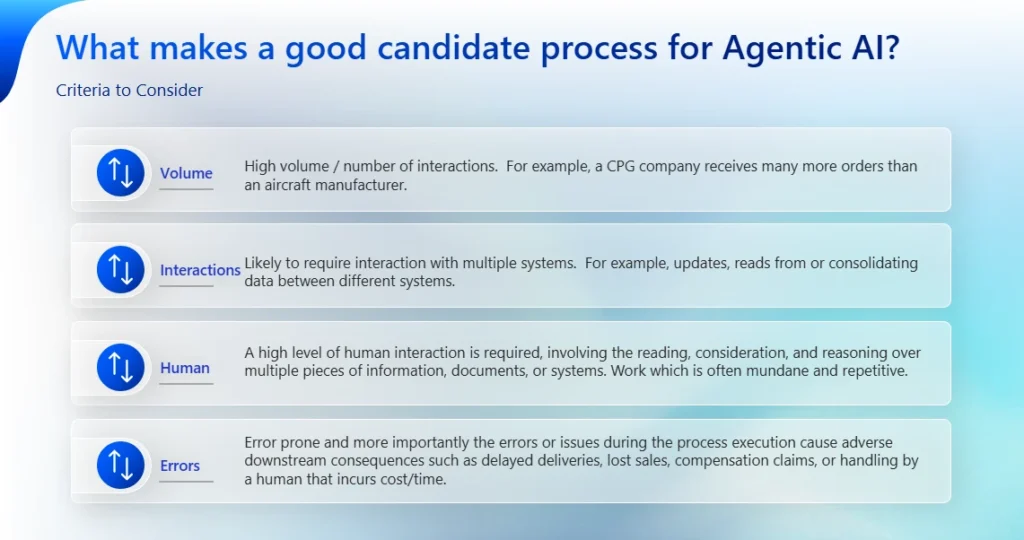
Basándonos en nuestra experiencia de trabajar con empresas minoristas y de bienes de consumo de todo el mundo, existen algunas tendencias comunes que pueden considerarse como criterios para determinar si un proceso específico, o parte de un proceso, es un buen caso de uso para la IA agentica.
Estos no se consideran criterios «estrictos y rápidos» que deben cumplirse, son tan solo pautas.
Volumen. Un proceso con grandes volúmenes o número de interacciones. Por ejemplo, una empresa de bienes de consumo recibe muchos más pedidos que un fabricante de aviones, por lo tanto, es probable que sea mucho más aplicable aplicar la IA agentiva a un proceso de entrada de pedidos en una empresa de bienes de consumo. Eso no significa que la IA agéntica no pueda ayudar a un fabricante de aviones con este proceso. Significa que el elemento de proceso específico donde se aplica sería diferente. Por ejemplo, al realizar un pedido de una aeronave, es posible que se necesiten varios documentos de configuración detallados, y la IA agéntica puede tener un papel valioso para garantizar que esos documentos sean correctos.
Interacción. Un proceso que interactúa con múltiples sistemas. Por ejemplo, actualiza, lee o consolida datos entre diferentes sistemas. Los procesos en los que los usuarios deben revisar, o consolidar, el contenido de varios sistemas son los principales candidatos para la aplicación de la IA agéntica. A veces denominados «integración de silla giratoria», este tipo de procesos son tediosos y están plagados de errores.
Humano. Un proceso en el que se requiere un alto nivel de interacción humana. Tal vez implique buscar, leer, considerar y razonar sobre múltiples piezas de información, documentos o sistemas. Por lo general, se trata de un trabajo mundano y repetitivo. La IA agentica puede evaluar y resaltar brechas, diferencias o anomalías. Puede hacer recomendaciones para que sean evaluadas por un humano y, como tal, está diseñada para trabajar junto o aumentar al ser humano al reducir la cantidad de actividad mundana y repetitiva. El elemento humano es fundamental en este caso: la IA permite que el ser humano se centre en las excepciones, el análisis estratégico y las decisiones complejas, al tiempo que apoya la innovación.
Errores. Procesos que son propensos a errores, lo que a menudo ocurre con operaciones humanas repetitivas y mundanas. Y lo que es más importante, uno en el que cualquier error o problema durante la ejecución del proceso provoca consecuencias adversas en el futuro, como retrasos en las entregas, pérdida de ventas, reclamaciones de indemnización o manipulación por parte de un ser humano que incurra en costes o tiempo. Esta puede ser un área clave de preocupación y enfoque.
Existe un requisito adicional, aunque hay que tenerlo en cuenta a la hora de diseñar una solución. Esto se relaciona con la disponibilidad de datos.
Es fundamental asegurarse de que los datos necesarios para la aplicación de IA agéntica estén disponibles y sean accesibles sin causar desafíos en otros lugares. Es común que los sistemas agénticos necesiten referirse a datos para ayudar a la toma de decisiones. Por ejemplo, puede ser necesario buscar algo en un registro maestro de cliente o proveedor en un sistema transaccional. Cuando muchos de estos se requieren en muy poco tiempo, puede ser que la solución agéntica cause problemas de rendimiento en el sistema transaccional. Desde el punto de vista arquitectónico, este desafío se puede evitar al extraer estos datos en un lago de datos u otro almacén de datos para que actúe como ubicación de referencia.
Definir el valor
Los avances posicionan a la IA agéntica como una piedra angular para crear una cadena de suministro más resiliente, eficiente, sostenible y autónoma. A la hora de evaluar el valor empresarial de cualquier inversión en tecnología, uno de los primeros puntos para tener en cuenta es determinar los impulsores específicos del valor. Además, es de igual importancia entender cómo se va a medir.
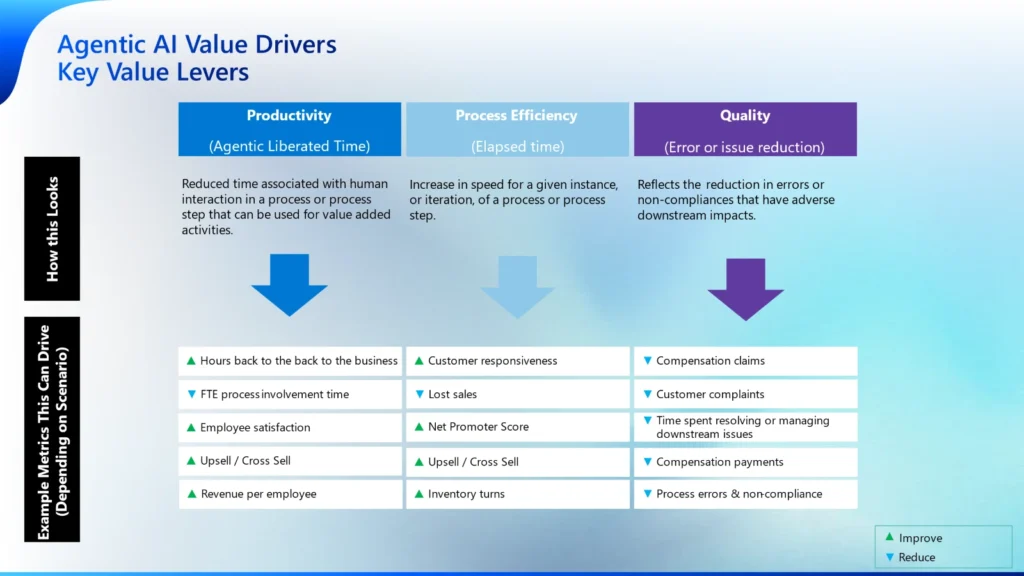
A partir del trabajo que hemos realizado en relación con la IA agéntica, el valor suele dividirse en tres áreas:
Productividad. Puedes pensar en esto como «tiempo liberado agéntico». Esto refleja la reducción del tiempo sin valor agregado asociado con la interacción humana en un proceso o etapa del proceso por medio del «tiempo liberado» para actividades de valor agregado. El alcance de estas actividades adicionales es fundamental para aportar valor a la IA agente. Por ejemplo, un minorista buscaba liberar tiempo para que sus planificadores de la cadena de suministro dedicaran más tiempo a los proveedores individuales que planificaban futuros inventarios promocionales. Los agentes de IA pueden agilizar las comunicaciones con los proveedores, supervisar el cumplimiento de los contratos y resolver disputas de forma eficiente.
Eficiencia del proceso. Esto se relaciona con el tiempo transcurrido que tarda un proceso. Los agentes de IA automatizan las tareas repetitivas y optimizan las operaciones, lo que conduce a mayores niveles de eficiencia de los procesos y menores costes. Esto, a su vez, tiene beneficios secundarios, por ejemplo, reducir el tiempo dedicado entre la recepción y el procesamiento de un pedido de un cliente se traduce en una mejor capacidad de respuesta al cliente.
Calidad. Esto a menudo puede verse como un cliché. Sin embargo, en este caso, el objetivo es la reducción de errores o problemas. En concreto, aquellos que tienen una consecuencia negativa aguas abajo dentro de la organización o la cadena de suministro. Por ejemplo, un inventario prometedor que no existe tendrá un impacto negativo en las puntuaciones de satisfacción del cliente y puede dar lugar a futuras ventas perdidas.
La medición es clave
Para cada una de estas áreas de impulsores de valor, es importante establecer las métricas o KPI que es probable que afectará en su caso específico. El gráfico anterior da algunos ejemplos, pero aquí es donde en verdad entra en vigor el valor de la IA agéntica.
Para el impulsor de valor de la productividad, el tiempo liberado se puede utilizar para identificar oportunidades adicionales de generación de ingresos, lo que puede mejorar su KPI de ingresos por empleado. Para la eficiencia de los procesos, la reducción de las ventas perdidas puede ser una métrica relevante si, por ejemplo, buscan automatizar el proceso de pedidos de sus clientes.
La calidad, sin embargo, es donde se vuelve interesante. Determinar las consecuencias negativas posteriores de una decisión tardía o mal informada puede ser difícil, pero vale la pena. Un enfoque para tener en cuenta es usar Microsoft Copilot para ayudar a idear esto, al pedir sugerencias sobre cuáles podrían ser las consecuencias negativas posteriores de los errores en un proceso en particular. Es posible que esto no arroje la respuesta exacta para su negocio, pero la práctica ha demostrado que por lo general inspira un nuevo pensamiento o perspectiva que se relaciona con su negocio.
Avanzar en el valor
La selección de los casos de uso adecuados para la IA agéntica requiere una comprensión profunda tanto de los criterios de implementación como de los impulsores del valor. Al centrarse en procesos de gran volumen y propensos a errores que requieren un esfuerzo humano significativo y la interacción con múltiples sistemas, las organizaciones pueden identificar las áreas más prometedoras para la aplicación de la IA.
Además, definir y medir el valor de las inversiones en IA a través de la productividad, la eficiencia de los procesos y las mejoras de calidad garantizará que las organizaciones puedan desbloquear todo el potencial de la IA agéntica. Con estas directrices, las organizaciones pueden tomar decisiones informadas y navegar por las complejidades de la selección de casos de uso de IA, lo que en última instancia impulsa la innovación y la eficiencia.
The post Ayudar a los minoristas y a las organizaciones de bienes de consumo a identificar los casos de uso de IA agentica más valiosos appeared first on Source LATAM.
Amazon Managed Streaming for Apache Kafka (Amazon MSK) now supports Apache Kafka version 3.8 on Express Brokers, introducing new features, bug fixes, and performance improvements for Kafka workloads running on Express Brokers. The update brings enhancements in data compression capabilities. You can now configure compression levels for lz4, zstd, and gzip formats, allowing precise control over the balance between compression efficiency and resource usage.
The transition to version 3.8 is straightforward – you can either create new clusters or upgrade your existing ones. For a detailed understanding of the specific improvements and bug fixes included in this release, see the Apache Kafka release notes for version 3.8.
Amazon Managed Streaming for Apache Kafka (Amazon MSK) now supports Apache Kafka version 3.8 on Express Brokers, introducing new features, bug fixes, and performance improvements for Kafka workloads running on Express Brokers. The update brings enhancements in data compression capabilities. You can now configure compression levels for lz4, zstd, and gzip formats, allowing precise control over the balance between compression efficiency and resource usage. The transition to version 3.8 is straightforward – you can either create new clusters or upgrade your existing ones. For a detailed understanding of the specific improvements and bug fixes included in this release, see the Apache Kafka release notes for version 3.8.
Powertools for AWS Lambda now offers a new Amazon Bedrock Agents Function utility that simplifies building serverless applications integrated with Amazon Bedrock Agents. This utility enables developers to easily create AWS Lambda functions that can respond to Amazon Bedrock Agent action requests with built-in parameter injection, response formatting, eliminating boilerplate code and accelerating development.
With the Amazon Bedrock Agents function utility, developers can focus on business logic while the utility handles the complex integration patterns between AWS Lambda and Amazon Bedrock Agents. The utility provides seamless integration with other Powertools features like Logger, Metrics, among other utilities, making it easier to build, test, and deploy production-ready AI applications. This integration significantly improves developer experience when building agent-based solutions that require Lambda functions to process actions requested by Bedrock Agents.
To learn more about the Amazon Bedrock Agents Function utility, visit the Powertools for AWS Lambda documentation (Python, TypeScript, .NET), and explore code examples in our GitHub repository. Get started with this new feature today by updating your Powertools for AWS Lambda dependency to the latest version.
Powertools for AWS Lambda now offers a new Amazon Bedrock Agents Function utility that simplifies building serverless applications integrated with Amazon Bedrock Agents. This utility enables developers to easily create AWS Lambda functions that can respond to Amazon Bedrock Agent action requests with built-in parameter injection, response formatting, eliminating boilerplate code and accelerating development. With the Amazon Bedrock Agents function utility, developers can focus on business logic while the utility handles the complex integration patterns between AWS Lambda and Amazon Bedrock Agents. The utility provides seamless integration with other Powertools features like Logger, Metrics, among other utilities, making it easier to build, test, and deploy production-ready AI applications. This integration significantly improves developer experience when building agent-based solutions that require Lambda functions to process actions requested by Bedrock Agents. To learn more about the Amazon Bedrock Agents Function utility, visit the Powertools for AWS Lambda documentation (Python, TypeScript, .NET), and explore code examples in our GitHub repository. Get started with this new feature today by updating your Powertools for AWS Lambda dependency to the latest version.
You can upgrade with just a few clicks in the Amazon RDS Management Console or by using the AWS SDK or CLI. Learn more about upgrading your database instances from the Amazon RDS Custom User Guide.
This CU is available in all AWS Regions where Amazon RDS Custom for SQL Server is available.
RDS Custom is a managed database service that allows customization of the underlying operating system and database environment. RDS Custom for SQL Server supports two licensing models: License Included (LI) and Bring Your Own Media (BYOM). By using Bring Your Own Media (BYOM), customers can use their existing SQL Server licenses with Amazon RDS Custom for SQL Server. See Amazon RDS Custom Pricing for pricing details and regional availability.
Amazon Relational Database Service (Amazon RDS) Custom for SQL Server now supports Cumulative Update (CU) 18 for Microsoft SQL Server 2022. This update is available for SQL Server Developer, Web, Standard, and Enterprise editions, and includes performance improvements and bug fixes. For more details about the improvements in this update, please review Microsoft KB5050771 release notes.
You can upgrade with just a few clicks in the Amazon RDS Management Console or by using the AWS SDK or CLI. Learn more about upgrading your database instances from the Amazon RDS Custom User Guide.
This CU is available in all AWS Regions where Amazon RDS Custom for SQL Server is available. RDS Custom is a managed database service that allows customization of the underlying operating system and database environment. RDS Custom for SQL Server supports two licensing models: License Included (LI) and Bring Your Own Media (BYOM). By using Bring Your Own Media (BYOM), customers can use their existing SQL Server licenses with Amazon RDS Custom for SQL Server. See Amazon RDS Custom Pricing for pricing details and regional availability.
Amazon Q Developer transformation capabilities now support customization of Java upgrades in Java upgrade transformation CLI (command line interface) with a new selective transformation feature. Using this feature, you can use natural language chat and/or an input file to tailor transformation plans and exercise greater control over Java upgrades. The following options are supported:
Selection of steps from a transformation plan and breakdown of a transformation job for granular code reviews
For first-party and third-party dependencies, the libraries and their versions you would like Q Developer to upgrade during JDK version upgrades
Amazon Q Developer Java upgrade capabilities now have been tested to offer enhanced transformation success rates, reducing the manual effort needed to complete your software modernization tasks.
The selective transformation feature for Java upgrades is available in the command line, on Linux and MacOS. To learn more and get started, please visit the documentation page.
Amazon Q Developer transformation capabilities now support customization of Java upgrades in Java upgrade transformation CLI (command line interface) with a new selective transformation feature. Using this feature, you can use natural language chat and/or an input file to tailor transformation plans and exercise greater control over Java upgrades. The following options are supported:
Selection of steps from a transformation plan and breakdown of a transformation job for granular code reviews
For first-party and third-party dependencies, the libraries and their versions you would like Q Developer to upgrade during JDK version upgrades
Amazon Q Developer Java upgrade capabilities now have been tested to offer enhanced transformation success rates, reducing the manual effort needed to complete your software modernization tasks. The selective transformation feature for Java upgrades is available in the command line, on Linux and MacOS. To learn more and get started, please visit the documentation page.