AWS Secrets Manager now enables customers to allocate and track cost for their secret usage. Customers can categorize their secret costs by department, team, or application using AWS cost allocation tags. You can leverage this feature by tagging your secrets and enabling them in Cost Allocation Tags.
Secrets Manager is a fully managed service that helps you manage, retrieve, and rotate database credentials, application credentials, API keys, and other secrets throughout their lifecycles. You can use Secrets Manager to replace hard-coded credentials in application source code with a runtime call to the Secrets Manager service to retrieve credentials dynamically when you need them.
For more information about cost allocation tags, visit the AWS Secrets Manager documentation. To get started, visit the launch blog post. The feature is available in all regions where AWS Secrets Manager is available. For a list of regions where Secrets Manager is available, see the AWS Region table.
AWS Secrets Manager now enables customers to allocate and track cost for their secret usage. Customers can categorize their secret costs by department, team, or application using AWS cost allocation tags. You can leverage this feature by tagging your secrets and enabling them in Cost Allocation Tags. Secrets Manager is a fully managed service that helps you manage, retrieve, and rotate database credentials, application credentials, API keys, and other secrets throughout their lifecycles. You can use Secrets Manager to replace hard-coded credentials in application source code with a runtime call to the Secrets Manager service to retrieve credentials dynamically when you need them. For more information about cost allocation tags, visit the AWS Secrets Manager documentation. To get started, visit the launch blog post. The feature is available in all regions where AWS Secrets Manager is available. For a list of regions where Secrets Manager is available, see the AWS Region table.
AWS Backup now provides fully managed data protection capabilities for Amazon Aurora DSQL, a serverless distributed SQL database for always available applications. As organizations build applications with Aurora DSQL, they can do so with confidence, knowing that their critical data is protected by AWS Backup. Using AWS Backup’s integration with AWS Organizations, you can centrally create and manage immutable backups across all your accounts, standardizing data protection across your organization.
From day one, customers can leverage AWS Backup’s comprehensive data protection features for Aurora DSQL, including automated scheduling, retention management, immutable and logically air-gapped vaults, cross-Region and cross-account copies, and cost-effective cold storage. This integration streamlines backup management, allowing organizations to unify their data protection strategy across Aurora DSQL and other AWS resources. AWS Backup enables customers to confidently adopt Aurora DSQL while maintaining a consistent approach to data protection across their entire AWS environment.
AWS Backup support for Amazon Aurora DSQL is available in all AWS Regions where both AWS Backup and Amazon Aurora DSQL are supported. For the most up-to-date information on Regional availability, please refer to the AWS Backup Regional availability.
AWS Backup now provides fully managed data protection capabilities for Amazon Aurora DSQL, a serverless distributed SQL database for always available applications. As organizations build applications with Aurora DSQL, they can do so with confidence, knowing that their critical data is protected by AWS Backup. Using AWS Backup’s integration with AWS Organizations, you can centrally create and manage immutable backups across all your accounts, standardizing data protection across your organization. From day one, customers can leverage AWS Backup’s comprehensive data protection features for Aurora DSQL, including automated scheduling, retention management, immutable and logically air-gapped vaults, cross-Region and cross-account copies, and cost-effective cold storage. This integration streamlines backup management, allowing organizations to unify their data protection strategy across Aurora DSQL and other AWS resources. AWS Backup enables customers to confidently adopt Aurora DSQL while maintaining a consistent approach to data protection across their entire AWS environment. AWS Backup support for Amazon Aurora DSQL is available in all AWS Regions where both AWS Backup and Amazon Aurora DSQL are supported. For the most up-to-date information on Regional availability, please refer to the AWS Backup Regional availability. To get started with AWS Backup for Aurora DSQL, visit the AWS Backup console or refer to the AWS Backup documentation. For more information about Amazon Aurora DSQL, please visit the Amazon Aurora DSQL documentation.
Amazon Relational Database Service (RDS) for MySQL now supports new Amazon RDS Extended Support minor version 5.7.44-RDS.20250508. We recommend that you upgrade to this version to fix known security vulnerabilities and bugs in prior versions of MySQL. Learn more about upgrading your database instances, including minor and major version upgrades, in the Amazon RDS User Guide.
Amazon RDS Extended Support provides you more time, up to three years, to upgrade to a new major version to help you meet your business requirements. During Extended Support, Amazon RDS will provide critical security and bug fixes for your MySQL databases on Aurora and RDS after the community ends support for a major version. You can run your MySQL databases on Amazon RDS with Extended Support for up to three years beyond a major version’s end of standard support date. Learn more about Extended Support in the Amazon RDS User Guide and the Pricing FAQs.
Amazon RDS for MySQL makes it simple to set up, operate, and scale MySQL deployments in the cloud. See Amazon RDS for MySQL Pricing for pricing details and regional availability. Create or update a fully managed Amazon RDS database in the Amazon RDS Management Console.
Amazon Relational Database Service (RDS) for MySQL now supports new Amazon RDS Extended Support minor version 5.7.44-RDS.20250508. We recommend that you upgrade to this version to fix known security vulnerabilities and bugs in prior versions of MySQL. Learn more about upgrading your database instances, including minor and major version upgrades, in the Amazon RDS User Guide. Amazon RDS Extended Support provides you more time, up to three years, to upgrade to a new major version to help you meet your business requirements. During Extended Support, Amazon RDS will provide critical security and bug fixes for your MySQL databases on Aurora and RDS after the community ends support for a major version. You can run your MySQL databases on Amazon RDS with Extended Support for up to three years beyond a major version’s end of standard support date. Learn more about Extended Support in the Amazon RDS User Guide and the Pricing FAQs. Amazon RDS for MySQL makes it simple to set up, operate, and scale MySQL deployments in the cloud. See Amazon RDS for MySQL Pricing for pricing details and regional availability. Create or update a fully managed Amazon RDS database in the Amazon RDS Management Console.
Today, AWS announces the general availability of Amazon Aurora DSQL, the fastest serverless, distributed SQL database with active-active high availability and multi-Region strong consistency. Aurora DSQL enables you build always available applications with virtually unlimited scalability, the highest availability, and zero infrastructure management. It is designed to make scaling and resilience effortless for your applications and offers the fastest distributed SQL reads and writes.
Aurora DSQL active-active distributed architecture is designed for 99.99% single-Region and 99.999% multi-Region availability with no single point of failure, and automated failure recovery. It offers multi-Region strong consistency which ensures all reads and writes to any Regional endpoint are strongly consistent and durable. Aurora DSQL independently scales reads, writes, compute, and storage, offering the flexibility and cost efficiency to both scale up and scale out to meet any workload demand without compromising performance. With today’s launch, we’ve added support for AWS Backup, AWS PrivateLink, AWS CloudFormation, AWS CloudTrail, AWS KMS customer managed keys, and PostgreSQL views. In addition, Aurora DSQL provides a Model Context Protocol (MCP) server for AI applications.
Aurora DSQL is available in the following AWS Regions: US East (N. Virginia), US East (Ohio), US West (Oregon), Asia Pacific (Osaka), Asia Pacific (Tokyo), Europe (Ireland), Europe (London), and Europe (Paris).
Today, AWS announces the general availability of Amazon Aurora DSQL, the fastest serverless, distributed SQL database with active-active high availability and multi-Region strong consistency. Aurora DSQL enables you build always available applications with virtually unlimited scalability, the highest availability, and zero infrastructure management. It is designed to make scaling and resilience effortless for your applications and offers the fastest distributed SQL reads and writes.
Aurora DSQL active-active distributed architecture is designed for 99.99% single-Region and 99.999% multi-Region availability with no single point of failure, and automated failure recovery. It offers multi-Region strong consistency which ensures all reads and writes to any Regional endpoint are strongly consistent and durable. Aurora DSQL independently scales reads, writes, compute, and storage, offering the flexibility and cost efficiency to both scale up and scale out to meet any workload demand without compromising performance. With today’s launch, we’ve added support for AWS Backup, AWS PrivateLink, AWS CloudFormation, AWS CloudTrail, AWS KMS customer managed keys, and PostgreSQL views. In addition, Aurora DSQL provides a Model Context Protocol (MCP) server for AI applications.
Aurora DSQL is available in the following AWS Regions: US East (N. Virginia), US East (Ohio), US West (Oregon), Asia Pacific (Osaka), Asia Pacific (Tokyo), Europe (Ireland), Europe (London), and Europe (Paris).
Get started with Aurora DSQL for free with the AWS Free Tier. Set up your database in only a few steps in the Aurora DSQL console or use the Aurora DSQL API or AWS CLI. To learn more, read the Aurora DSQL overview page, blog post, pricing page, and documentation.
Today, AWS Backup announces support for the creation of backup indexes in backup policies, allowing you to automatically create backup indexes of your Amazon S3 backups or Amazon EBS snapshots at the AWS Organization level. The creation of a backup index is the prerequisite for searching your backups. Once the backup index is created, you can perform a search and item level recovery of your S3 backups or EBS snapshots. You can now use your Organization management account to set a backup indexing policy across your AWS accounts.
To get started, create a new or edit an existing AWS Backup policy from your AWS Organization management account. You can designate your backup policies to automatically create a backup index of your S3 backups and/or EBS Snapshots. Once your backup is indexed, you can search across multiple backups to locate specific files or objects. You can specify your search criteria based on one or more filters such as file name, creation time, and size. Once you identify the specific files or objects you are looking for, you can choose to restore just these items to an Amazon S3 bucket rather than restoring the full backup, allowing for quicker recovery times.
AWS Backup support for backup indexes in backup policies is available in all AWS Commercial and AWS GovCloud (US) Regions, where AWS Backup, backup policies, and backup indexes are available. You can get started by using the AWS Organizations API, or CLI. For more information, visit our documentation and blog post.
Today, AWS Backup announces support for the creation of backup indexes in backup policies, allowing you to automatically create backup indexes of your Amazon S3 backups or Amazon EBS snapshots at the AWS Organization level. The creation of a backup index is the prerequisite for searching your backups. Once the backup index is created, you can perform a search and item level recovery of your S3 backups or EBS snapshots. You can now use your Organization management account to set a backup indexing policy across your AWS accounts. To get started, create a new or edit an existing AWS Backup policy from your AWS Organization management account. You can designate your backup policies to automatically create a backup index of your S3 backups and/or EBS Snapshots. Once your backup is indexed, you can search across multiple backups to locate specific files or objects. You can specify your search criteria based on one or more filters such as file name, creation time, and size. Once you identify the specific files or objects you are looking for, you can choose to restore just these items to an Amazon S3 bucket rather than restoring the full backup, allowing for quicker recovery times. AWS Backup support for backup indexes in backup policies is available in all AWS Commercial and AWS GovCloud (US) Regions, where AWS Backup, backup policies, and backup indexes are available. You can get started by using the AWS Organizations API, or CLI. For more information, visit our documentation and blog post.
Las pequeñas y medianas empresas (PyMEs) son el corazón económico de las Américas, representan aproximadamente el 99.5% de todas las empresas y generan cerca del 60% del empleo productivo formal en la región, de acuerdo con cifras de la OCDE. En la actualidad, la adopción de tecnologías avanzadas, como la inteligencia artificial (IA), se ha convertido en un factor crucial para que estas empresas mantengan su competitividad y eficiencia.
La transformación impulsada por la IA promete un cambio profundo y duradero en el panorama empresarial. Las PyMEs ocupan una posición privilegiada en esta transformación, al aprovechar la IA disponible para escalar más rápido, moverse con mayor agilidad y crear valor de formas que nunca habíamos visto. A medida que se vuelve más accesible, la IA se posiciona como una herramienta esencial en un mercado cada vez más competitivo.
Para comprender mejor cómo la tecnología y en específico la IA moldea el futuro de las PyMEs, llevamos a cabo la quinta edición de nuestra encuesta anual al sector, titulada «IA en las PyMEs: Tendencias, Desafíos y Oportunidades». Para ello, encuestamos a líderes de siete países de América — Argentina, Brasil, Canadá, Colombia, Costa Rica, México y Puerto Rico— que cubren sectores como retail, manufactura, tecnología y telecomunicaciones. Los resultados revelan cómo estas empresas adoptan la IA, qué impulsa o frena su uso, y su impacto en productividad, ciberseguridad y formación laboral.
La revolución silenciosa: IA en las PyMEs
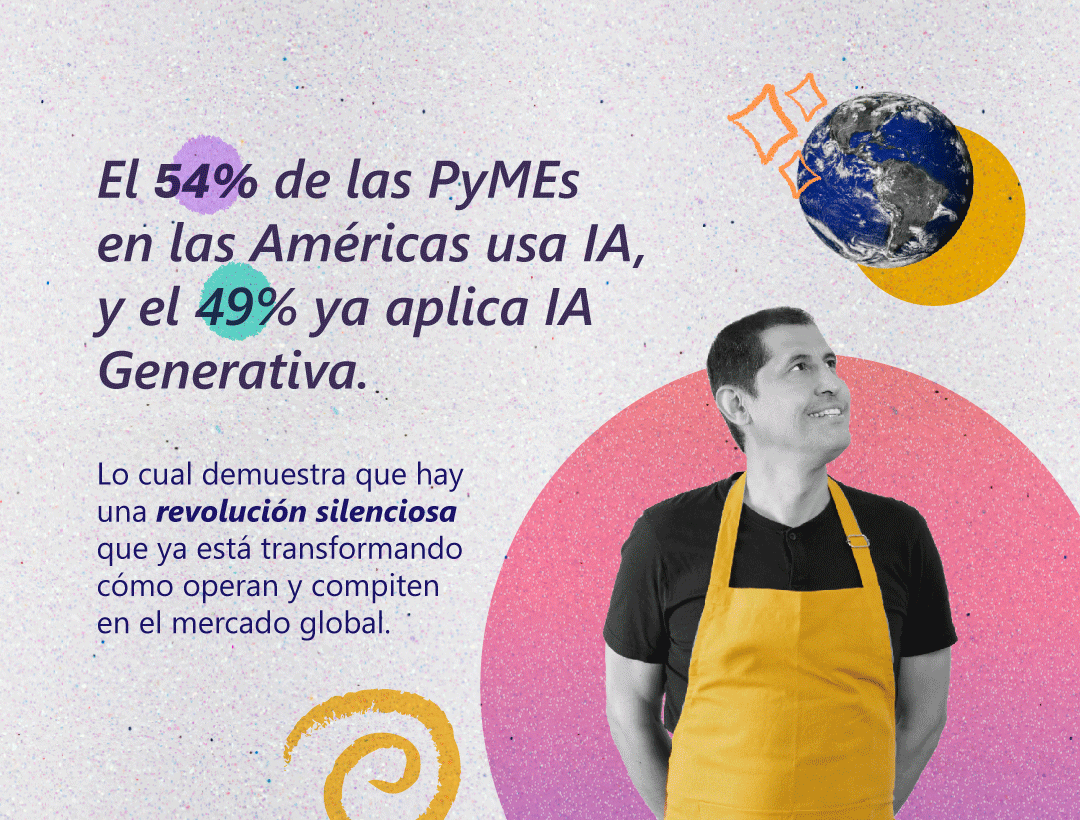
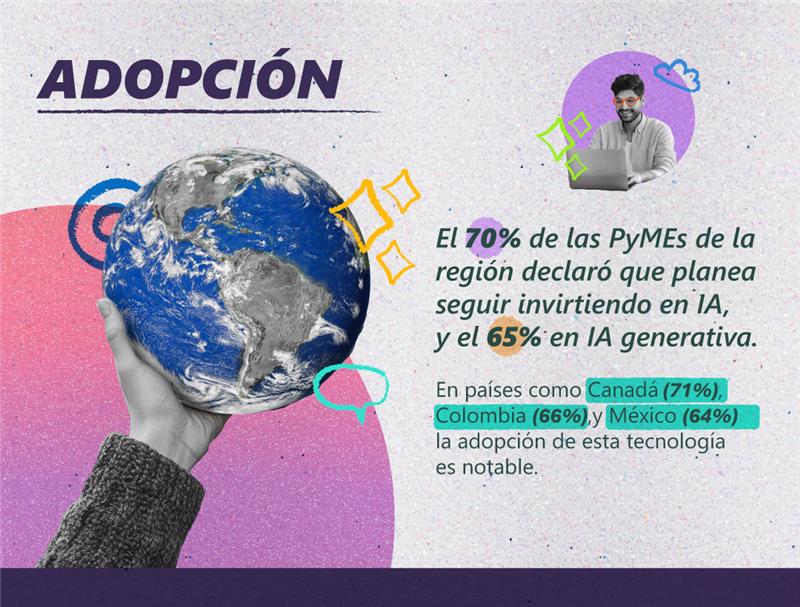
De acuerdo con la encuesta, el 54% de las PyMEs en las Américas usa IA, y el 49% ya aplica IA Generativa (Gen IA, por sus siglas en inglés), lo cual demuestra que hay una revolución silenciosa que ya está transformando cómo operan y compiten en el mercado global. En países como Canadá (71%), Colombia (66%) y México (64%), la adopción de esta tecnología es notable. Además, el 70% de las PyMEs de la región declaró que planea seguir invirtiendo en IA y el 65% en IA generativa, lo que manifiesta una intención firme de integrarla en sus operaciones.
José Gómez Cueto, gerente general de PyMEs en Microsoft para las Américas, comenta al respecto: «La IA transforma el panorama empresarial de las PyMEs, permitiéndoles no solo mantenerse competitivas, sino también liderar en innovación y eficiencia. En Microsoft, nuestro objetivo es brindarles un acompañamiento adecuado, así como las herramientas necesarias para que puedan escalar más rápido y crear valor de formas innovadoras”.
Transformar la eficiencia y la satisfacción con IA
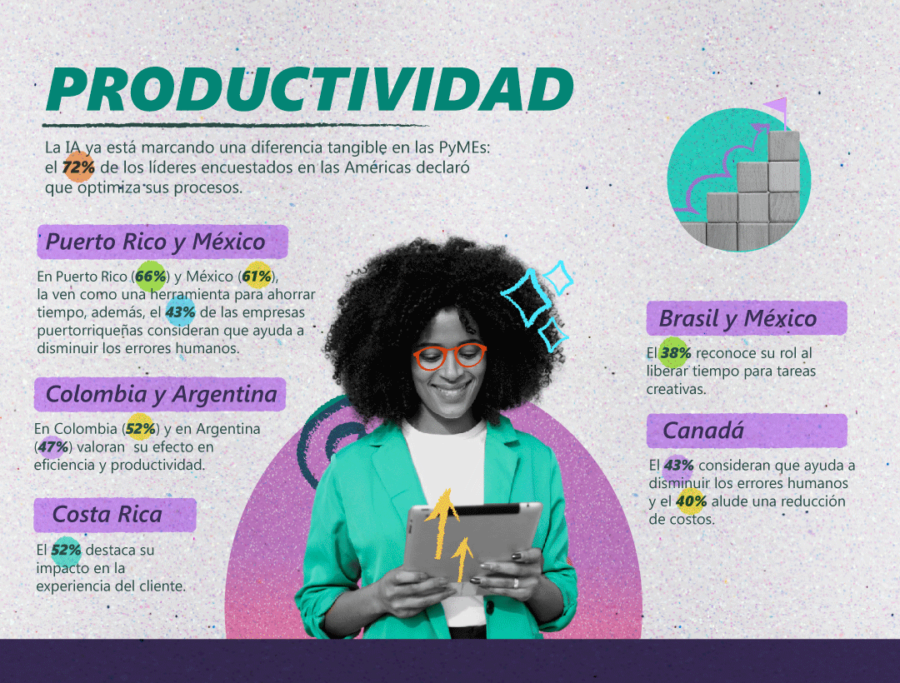
La IA ya está marcando una diferencia tangible en las PyMEs: el 72% de los líderes encuestados en las Américas declaró que optimiza sus procesos. En Puerto Rico (66%) y México (61%), la ven como una herramienta para ahorrar tiempo, además, el 43% de las empresas puertorriqueñas y canadienses consideran que ayuda a disminuir los errores humanos; en Costa Rica, el 52% destaca su impacto en la experiencia del cliente; mientras que, en Colombia (52%) y en Argentina (47%) valoran su efecto en eficiencia y productividad; y en Brasil y México se reconoce su rol al liberar tiempo para tareas creativas (38%) y 40% de las empresas canadienses alude una reducción de costos.
Estos beneficios no solo optimizan los procesos internos, sino que también elevan la experiencia de colaboradores y clientes, transformando la eficiencia operativa en satisfacción tangible y ventaja competitiva.
Navegar el camino de la IA: Desafíos en adopción y seguridad
Sin embargo, el avance en la adopción de IA también presenta algunos desafíos importantes para las PyMEs. Un ejemplo de estos desafíos es la seguridad. En 2023, el 24% de las PyMEs sufrió amenazas relacionadas con IA.
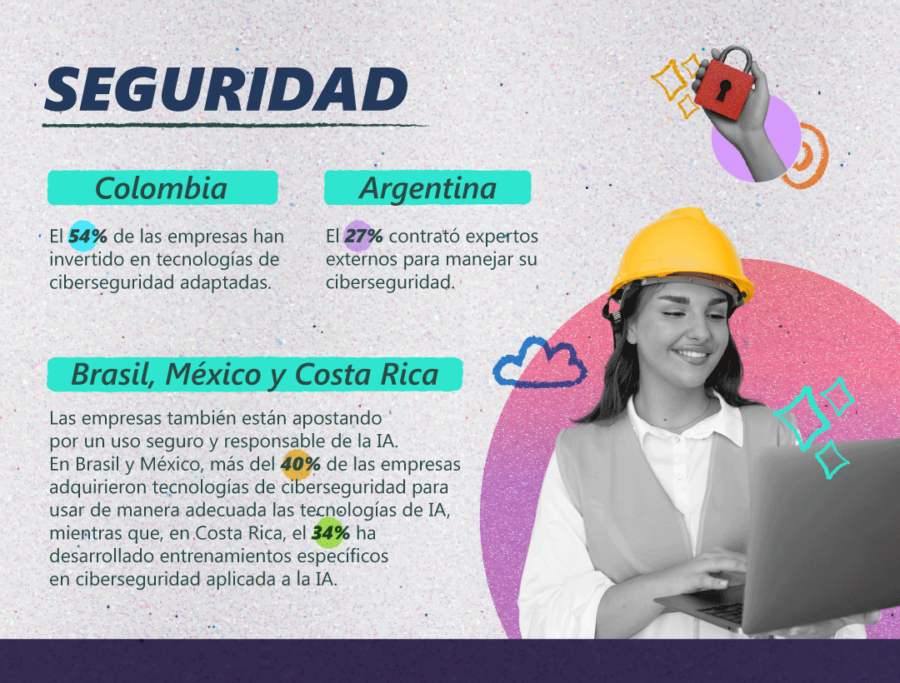
En respuesta, el 54% de las empresas en Colombia ha invertido en tecnologías de ciberseguridad adaptadas, y en Argentina, el 27% contrató expertos externos para manejar su ciberseguridad. En países como Brasil, México y Costa Rica, las empresas también están apostando por un uso seguro y responsable de la IA: más del 40% en Brasil y México han adquirido tecnologías de ciberseguridad para usar de manera adecuada las tecnologías de IA, mientras que, en Costa Rica, el 34% ha desarrollado entrenamientos específicos en ciberseguridad aplicada a la IA.
Estos retos son también oportunidades para fortalecer la infraestructura tecnológica y asegurar un uso seguro y eficaz de la IA.
El papel crucial de la IA en el futuro de las PyMEs
La adopción de la IA está redefiniendo el rumbo de las PyMEs en la región, impulsando la innovación y fortaleciendo su capacidad para adaptarse y crecer en un entorno cada vez más dinámico. A pesar de los desafíos, la inversión en IA se mantiene como una prioridad para muchas empresas.
«Nuestra encuesta demuestra que el compromiso de las PyMEs con la IA es significativo. Su inversión y adopción en IA mejora la eficiencia y productividad, y les permite abrir nuevas oportunidades para la innovación y el crecimiento. Esta tecnología permite optimizar operaciones, mejorar la experiencia del cliente y tomar decisiones basadas en datos, lo que al final, impulsa su competitividad”, apuntó José Gómez Cueto.
Si miramos hacia el futuro, es evidente que la IA se mantendrá como una herramienta esencial para las PyMEs, que las fortalecerá e impulsará su innovación y crecimiento. Las empresas que adopten la IA de manera estratégica estarán mejor posicionadas para enfrentar los retos del mercado global y aprovechar las oportunidades emergentes.
Para aprovechar al máximo las oportunidades que ofrece la IA, Microsoft ofrece soluciones avanzadas y soporte especializado para facilitar la adopción de estas tecnologías. Además, Microsoft proporciona una amplia gama de recursos de capacitación y desarrollo de habilidades en IA, diseñados para ayudar a empresas y personas a aprender y aprovechar mejor la IA.
Desde cursos en línea y certificaciones hasta programas de formación específicos para roles empresariales y técnicos, Microsoft está comprometido en cerrar la brecha de habilidades en IA y preparar a la fuerza laboral para el futuro. Descubran cómo Microsoft puede ayudarles a transformar su negocio con IA y mantenerse competitivos en el mercado global.
AWS Deadline Cloud Monitor now supports multiple languages, allowing you to view critical job information using an expanded selection of languages. Supported languages include Chinese (Traditional), Chinese (Simplified), English, French, German, Indonesian, Italian, Japanese, Korean, Portuguese (Brazil), and Turkish. AWS Deadline Cloud is a fully managed service that simplifies render management for teams creating computer-generated graphics and visual effects for films, television, broadcasting, web content, and design.
This new localization feature gives you the ability to manage and monitor information about rendering jobs in your preferred language, reducing complexity and improving workflow efficiency. The Deadline Cloud Monitor will automatically match your system languages used in both the desktop and web application, but can also be manually configured.
Multi-language support for AWS Deadline Cloud Monitor is available in all AWS Regions where the service is offered. To learn more about AWS Deadline Cloud Monitor and its new localization feature, see the AWS Deadline Cloud documentation.
AWS Deadline Cloud Monitor now supports multiple languages, allowing you to view critical job information using an expanded selection of languages. Supported languages include Chinese (Traditional), Chinese (Simplified), English, French, German, Indonesian, Italian, Japanese, Korean, Portuguese (Brazil), and Turkish. AWS Deadline Cloud is a fully managed service that simplifies render management for teams creating computer-generated graphics and visual effects for films, television, broadcasting, web content, and design. This new localization feature gives you the ability to manage and monitor information about rendering jobs in your preferred language, reducing complexity and improving workflow efficiency. The Deadline Cloud Monitor will automatically match your system languages used in both the desktop and web application, but can also be manually configured. Multi-language support for AWS Deadline Cloud Monitor is available in all AWS Regions where the service is offered. To learn more about AWS Deadline Cloud Monitor and its new localization feature, see the AWS Deadline Cloud documentation.
Starting today, Route 53 Profiles is available in Asia Pacific (Thailand), Mexico (Central), and Asia Pacific (Malaysia) Regions.
Route 53 Profiles allows you to define a standard DNS configuration (Profile), that may include Route 53 private hosted zone (PHZ) associations, Route 53 Resolver rules, and Route 53 Resolver DNS Firewall rule groups, and apply this configuration to multiple VPCs in your account. Route 53 Profiles can also be used to enforce DNS settings for your VPCs, with configurations for DNSSEC validations, Resolver reverse DNS lookups, and the DNS Firewall failure mode. You can share Profiles with AWS accounts in your organization using AWS Resource Access Manager (RAM). Route 53 Profiles simplifies the association of Route 53 resources and VPC-level settings for DNS across VPCs and AWS accounts in a Region with a single configuration, minimizing the complexity of having to manage each resource association and setting per VPC.
Route 53 Profiles is available in the AWS Regions mentioned here. To get started with this feature, visit the Route 53 documentation. To learn more about pricing, you can visit the Route 53 pricing page.
Starting today, Route 53 Profiles is available in Asia Pacific (Thailand), Mexico (Central), and Asia Pacific (Malaysia) Regions. Route 53 Profiles allows you to define a standard DNS configuration (Profile), that may include Route 53 private hosted zone (PHZ) associations, Route 53 Resolver rules, and Route 53 Resolver DNS Firewall rule groups, and apply this configuration to multiple VPCs in your account. Route 53 Profiles can also be used to enforce DNS settings for your VPCs, with configurations for DNSSEC validations, Resolver reverse DNS lookups, and the DNS Firewall failure mode. You can share Profiles with AWS accounts in your organization using AWS Resource Access Manager (RAM). Route 53 Profiles simplifies the association of Route 53 resources and VPC-level settings for DNS across VPCs and AWS accounts in a Region with a single configuration, minimizing the complexity of having to manage each resource association and setting per VPC. Route 53 Profiles is available in the AWS Regions mentioned here. To get started with this feature, visit the Route 53 documentation. To learn more about pricing, you can visit the Route 53 pricing page.
Anthropic’s Claude 3.5 Sonnet v1 and Claude 3 Haiku, and Meta’s Llama 3 8B and 70B models are now FedRAMP High and Department of Defense Cloud Computing Security Requirements Guide (DoD CC SRG) Impact Level (IL) 4 and 5 approved within Amazon Bedrock in the AWS GovCloud (US) Regions. Additionally, Amazon Bedrock features including Agents, Guardrails, Knowledge Bases, and Model Evaluation are now approved.
Federal agencies, public sector organizations, and other enterprises with FedRAMP High compliance requirements can now use Amazon Bedrock to access high-performing foundation models (FMs) from Anthropic and Meta.
Anthropic’s Claude 3.5 Sonnet v1 and Claude 3 Haiku, and Meta’s Llama 3 8B and 70B models are now FedRAMP High and Department of Defense Cloud Computing Security Requirements Guide (DoD CC SRG) Impact Level (IL) 4 and 5 approved within Amazon Bedrock in the AWS GovCloud (US) Regions. Additionally, Amazon Bedrock features including Agents, Guardrails, Knowledge Bases, and Model Evaluation are now approved. Federal agencies, public sector organizations, and other enterprises with FedRAMP High compliance requirements can now use Amazon Bedrock to access high-performing foundation models (FMs) from Anthropic and Meta. To learn more, visit the Amazon Bedrock product page and Amazon Bedrock documentation. To get started, visit the Amazon Bedrock console.
CloudWatch Database Insights announces support for Amazon Aurora PostgreSQL Limitless databases. Database Insights is a database observability solution that provides a curated experience designed for DevOps engineers, application developers, and database administrators (DBAs) to expedite database troubleshooting and gain a holistic view into their database fleet health.
Database Insights consolidates logs and metrics from your applications, your databases, and the operating systems on which they run into a unified view in the console. Using its pre-built dashboards, recommended alarms, and automated telemetry collection, you can monitor the health of your database fleets and use a guided troubleshooting experience to drill down to individual instances for root-cause analysis. You can now enable Database Insights on Aurora Limitless databases and start monitoring how database load is spread across your Limitless shard groups.
You can get started with Database Insights for Aurora Limitless by enabling it on your Limitless databases using the Aurora service console, AWS APIs, and SDKs.
Database Insights for Aurora Limitless is available in all regions where Aurora Limitless is available and applies a new ACU-based pricing – see pricing page for details. For further information, visit the Database Insights documentation.
CloudWatch Database Insights announces support for Amazon Aurora PostgreSQL Limitless databases. Database Insights is a database observability solution that provides a curated experience designed for DevOps engineers, application developers, and database administrators (DBAs) to expedite database troubleshooting and gain a holistic view into their database fleet health. Database Insights consolidates logs and metrics from your applications, your databases, and the operating systems on which they run into a unified view in the console. Using its pre-built dashboards, recommended alarms, and automated telemetry collection, you can monitor the health of your database fleets and use a guided troubleshooting experience to drill down to individual instances for root-cause analysis. You can now enable Database Insights on Aurora Limitless databases and start monitoring how database load is spread across your Limitless shard groups. You can get started with Database Insights for Aurora Limitless by enabling it on your Limitless databases using the Aurora service console, AWS APIs, and SDKs. Database Insights for Aurora Limitless is available in all regions where Aurora Limitless is available and applies a new ACU-based pricing – see pricing page for details. For further information, visit the Database Insights documentation.